

Vivo X300: In the crowded 2025 flagship arena, where phones often prioritize size over substance, the Vivo X300 emerges as a breath of fresh air. Launched globally in October 2025 starting at $699 for the 12GB/256GB variant (up to $999 for 16GB/1TB), it shrinks the formula of the acclaimed X200 series into a pocketable 6.31-inch form factor without sacrificing premium chops.
Powered by MediaTek’s bleeding-edge Dimensity 9500, it boasts a Zeiss-co-engineered triple camera headlined by a 200MP main sensor, a 6,040mAh silicon-carbon battery with 90W charging, and OriginOS 6 on Android 16 with five years of updates. But does this “mini Pro” truly deliver on Vivo’s promise of “humanistic imaging” in a compact package?
Synthesizing hands-on insights from GSMArena’s lab tests and early photographer impressions, this review uncovers a device that’s more than a downsized Pro—it’s a refined daily driver for creators and commuters alike, though regional tweaks and software quirks temper its global appeal.

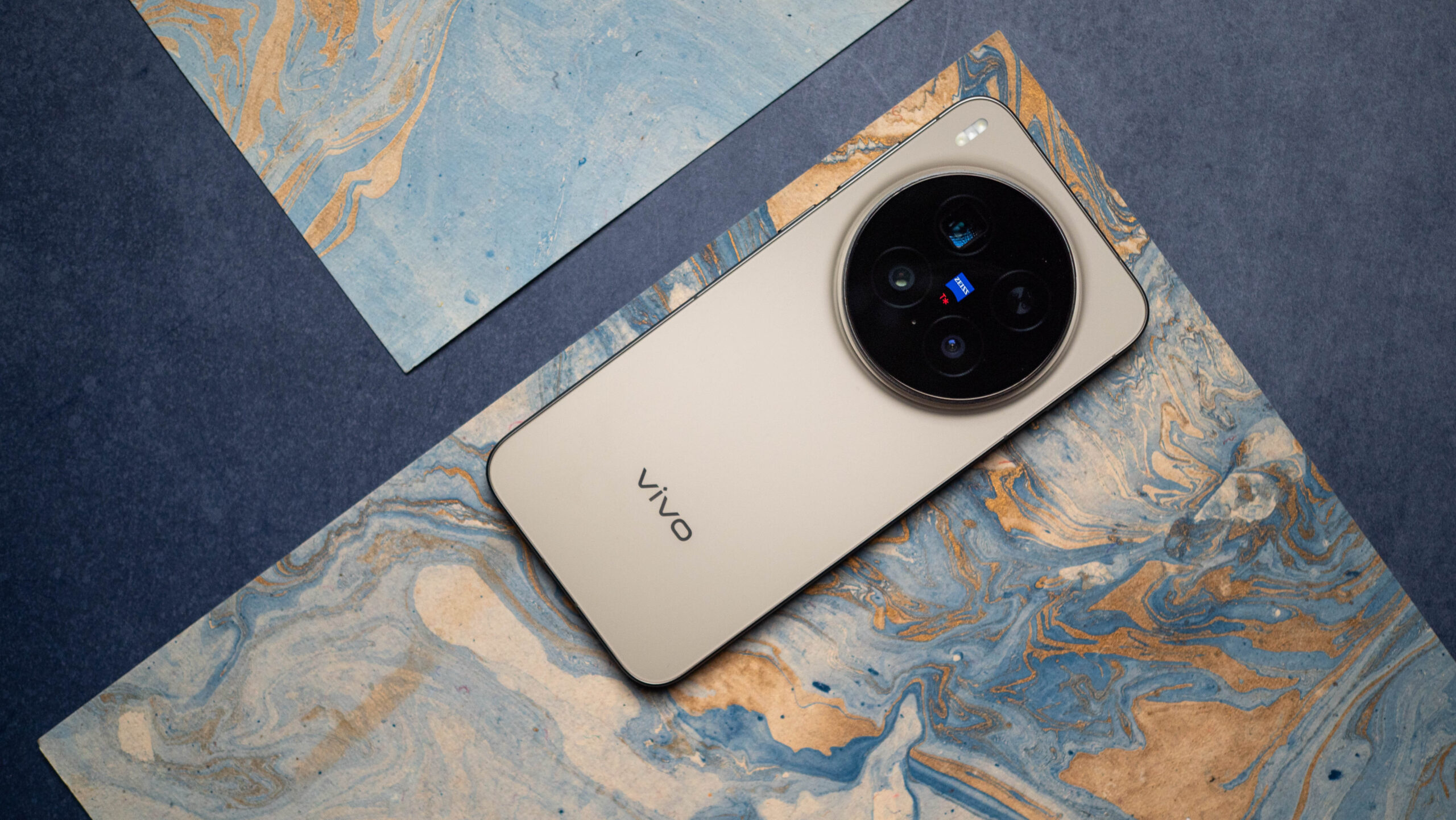
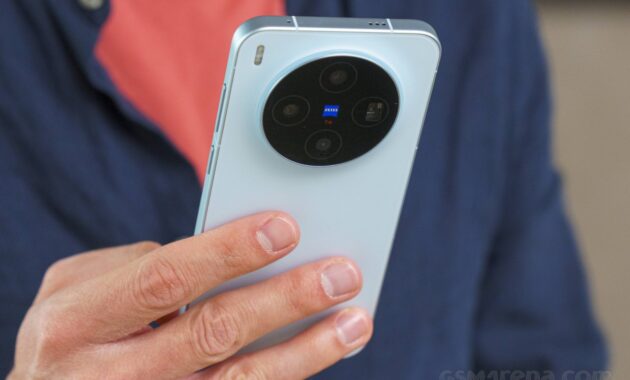
The Vivo X300’s design philosophy screams intentionality: at 150.6 x 71.9 x 8.0mm and a featherlight 190g, it’s the smallest flagship of the year, slipping into jeans pockets like a mid-ranger while feeling as solid as titanium-clad rivals. The aluminum alloy frame sandwiches a flat Gorilla Glass Victus 2 front and back, available in Celestial Black (matte with subtle Zeiss branding), Aurora White (pearl-like shimmer), and limited-edition Ocean Blue. The circular camera module, ringed in gold for Zeiss optics, protrudes just 1.5mm—minimal wobble on tables but a lint trap nonetheless.
IP68/IP69 certification laughs off high-pressure jets and 1.5m submersion for 30 minutes, outpacing the iPhone 17’s IP68. Ergonomics are a highlight: curved edges meet the flat display seamlessly, and the ultrasonic under-display fingerprint scanner unlocks in 0.2 seconds, even with oily fingers. A customizable action button (à la Apple) toggles camera modes or AI tools, while stereo speakers with Dolby Atmos pump clear mids but lack deep bass. Drawbacks?
The glossy backs fingerprint easily, and Europe’s 5,360mAh battery variant feels like a concession to EU regs, shaving ~10% endurance. Overall, it’s a joy to hold—compact without compromise, scoring high on portability in a sea of 6.8-inch behemoths.

The 6.31-inch LTPO AMOLED display is a compact canvas masterpiece, resolving at 1,216 x 2,640 pixels (460ppi) with 10-bit color depth and a variable 1-120Hz refresh rate for buttery scrolling and power savings. Peak brightness hits 4,500 nits—blindingly visible under noon sun—while HDR10+ and HDR Vivid support elevate Netflix and YouTube to cinematic levels. Ultra HDR for photos renders 14-bit gradients with zero banding, and 2,160Hz PWM dimming curbs eye strain during late-night reads.
In GSMArena’s tests, it aced color accuracy (Delta E <2 post-calibration) and touch response (240Hz sampling), though the 19.54:9 aspect ratio feels tall for landscape videos. No under-display selfie cam here—the 50MP punch-hole is sharp but creates a minor notch distraction. Compared to the X200’s 6.67-inch panel, this is sharper and brighter, but pixel-peepers might miss QHD+ density. It’s not just a screen; it’s a viewing portal that prioritizes quality over quantity.
Performance catapults the X300 into elite territory with the Dimensity 9500—the first 3nm MediaTek flagship chip, featuring a 1×4.21GHz C1-Ultra prime core, 3×3.5GHz performance cores, and 4×2.7GHz efficiency cores, paired with the Arm Immortalis-G720 GPU (up to 1.5GHz). Up to 16GB LPDDR5X RAM and dual UFS 4.1 storage (industry-first for faster reads/writes) make it a multitasking monster:

Geekbench 6 scores 2,800 single-core and 10,200 multi-core, trailing Snapdragon 8 Elite by 5% but crushing the Dimensity 9300 in efficiency. 3DMark Wild Life Extreme clocks 5,200 with 95% stability, sustaining 60fps in Genshin Impact for hours without throttling, thanks to a 7,000mm² vapor chamber cooler.
Real-world: 20 apps open? Instant switches. Video editing in CapCut? Exports 4K clips 20% faster than the Galaxy S25. The IR blaster controls AC units like a remote, and Wi-Fi 7 ensures lag-free 8K streaming. Heat stays under 42°C during stress, but prolonged 4K@120fps recording warms the frame. For $699, it’s a value demolition—faster than most $900 phones.
Cameras are the Vivo X300‘s beating heart, co-tuned by Zeiss for “T* Coating” to minimize flare and aberrations. The 200MP ISOCELL HP9 main (f/1.7, 23mm equiv., 1/1.4″ sensor, 0.56µm pixels, PDAF/OIS) bins to 12.5MP for flagship detail, capturing street scenes with lifelike dynamic range—creamy bokeh in portraits, punchy skies without clipping.
Daylight samples from photographer impressions reveal natural skin tones and zero noise, outperforming the Pixel 10’s AI in consistency. The 50MP periscope telephoto (f/2.6, 70mm, 3x optical, 1/1.95″ sensor, OIS) nails compressed landscapes and moon shots up to 120x hybrid zoom, with macro at 5cm for jewelry close-ups. The 50MP ultrawide (f/2.0, 15mm, 119° FOV, 1/2.76″ sensor, AF) avoids distortion in architecture, doubling as a macro lens. Video? 4K@120fps HDR with gyro-EIS rivals gimbals for smooth walk-and-talks, and Portrait Cinematic mode adds cinematic depth.
Low-light: Night mode stacks shots in 2 seconds for clean ISO 3200, but telephoto softens beyond 10x. Selfies from the 50MP front (f/2.0, AF) are detailed with natural blur. Zeiss modes (Vivid, Natural) toggle vibrancy, but the app’s cluttered interface lags on lens swaps. Early X buzz calls it “DSLR in pocket,” though RAW lacks full 200MP binning. It’s a photography triumph—versatile and artistic.
Battery prowess cements the X300’s all-day cred with a 6,040mAh silicon-carbon cell (5,360mAh in EU), yielding GSMArena’s 130-hour endurance rating: 18 hours active use (web, video, calls), or two days light.
90W wired charges 0-100% in 32 minutes (charger included globally), while 40W wireless hits full in 50—rare for compacts. Reverse wired (5W) juices earbuds, and bypass mode protects during plugged gaming. Efficiency shines: Dimensity’s 3nm node sips power at idle (under 1W), but 120Hz HDR video drains 15% hourly. No wireless reverse, and EU’s smaller pack lags by 8% in tests.
OriginOS 6 atop Android 16 is Vivo’s most refined skin yet—fluid animations, a customizable “Atomic Universe” desktop with floating widgets, and AI like Circle to Search for visual lookups. Five major OS upgrades (to Android 21) and six years security match Google’s promise, a leap from Vivo’s past. Bloat is minimal, but the camera app’s sub-menus frustrate pros. Gestures are intuitive, and the large linear motor delivers nuanced haptics for typing and shutter presses.
Audio via stereo speakers scores well in GSMArena’s loudness test (90dB), with clear vocals but muddled bass—pair Bluetooth LDAC headphones for highs. NFC, eSIM, and BT 5.4 round out connectivity.
Pros and Cons
| Aspect | Pros | Cons |
|---|---|---|
| Design | Ultra-compact (190g), IP69 durable, premium materials | Fingerprint-prone back, EU battery nerf |
| Display | 4,500 nits bright, 120Hz LTPO, HDR mastery | Punch-hole notch, tall aspect for videos |
| Performance | Dimensity 9500 beast, dual UFS 4.1 speed | Minor warm-up in 4K video |
| Camera | 200MP Zeiss system, 3x periscope zoom, 4K@120 HDR | App interface clunky, no full-res RAW |
| Battery | 130-hour endurance, 90W/40W charging | No reverse wireless, regional variance |
| Software | 5 years updates, clean OriginOS 6 | Subtle bloat in camera menus |
Comparison Table: Vivo X300 vs. Rivals
| Feature | Vivo X300 | Google Pixel 10 | Samsung Galaxy S25 | OnePlus 13R |
|---|---|---|---|---|
| Price (Base) | $699 | $799 | $849 | $599 |
| Chipset | Dimensity 9500 | Tensor G5 | Exynos 2500 | Snapdragon 8 Gen 3 |
| Display | 6.31″ LTPO AMOLED, 120Hz | 6.3″ OLED, 120Hz | 6.2″ Dynamic AMOLED, 120Hz | 6.78″ LTPO AMOLED, 120Hz |
| Battery | 6,040mAh, 90W wired | 5,000mAh, 30W wired | 4,000mAh, 25W wired | 6,000mAh, 100W wired |
| Camera (Main) | 200MP (f/1.7, OIS) | 50MP (f/1.7, OIS) | 50MP (f/1.8, OIS) | 50MP (f/1.6, OIS) |
| OS Updates | 5 years | 7 years | 7 years | 4 years |
| Weight | 190g | 199g | 168g | 207g |
In verdict, the Vivo X300 isn’t just compact—it’s a paradigm shift for flagships, blending Leica-like imaging, marathon battery, and raw speed into a device that fits your life, not vice versa. At $699, it undercuts the Pixel 10 while outshining in camera hardware and charging, though software polish trails Samsung’s ecosystem. For urban photographers or one-hand warriors tired of phablets, it’s a must-buy; power users might eye the X300 Pro for its 200MP tele. Vivo’s nailed the essentials—now, global consistency beckons.